Patrick Henry College rivals the academic strength of any Ivy League or elite institution.
PHC selects the best and brightest students who consistently rank among the highest in the nation on standardized tests. More importantly, they have made a commitment to follow Christ and seek His will.
The PHC distinctives—high academic rigor, fidelity to the spirit of the American founding, and an unwavering biblical worldview—allow us to educate the brightest Christian students to compete and lead at the highest levels of society.
At Patrick Henry College, students receive a broad-based baccalaureate education that stresses content, the imitation of excellence, the pursuit of knowledge, and the exercise of the whole range of talents that God has given, in the light of the truth that He has revealed in the inerrant Bible.
The 63-credit core curriculum plus foreign language proficiency—consisting of courses in logic, rhetoric, philosophy, mathematics, geometry, music, science, history, literature, theology, apologetics, economics, foreign languages, constitutional law, and political theory—lays a common foundation for advanced learning in each of seven major programs. Within the context of the classical liberal arts as a time-tested framework, courses mirror the trivium's emphasis on knowledge (grammar), understanding (logic), and application (rhetoric).
The culminating experience of a student's PHC degree is an apprenticeship, such as an internship, that applies the "rhetoric" of creative performance in the field of study. Regardless of major, students are invited to explore the interconnectedness of all the disciplines, reflecting the truth that in Christ "all things hold together" (Colossians 1:17).
Read PHC's Philosophy of Education or view the core curriculum.
.jpg?width=300&height=450&name=Graduation%202016%20(11).jpg)
Enrollment (Fall 2025) – 436 students, most of whom live in the College’s colonial-style residence halls; 87% fall-to-fall retention rate; 84% fall-to-fall retention rate of the first-year freshmen cohort
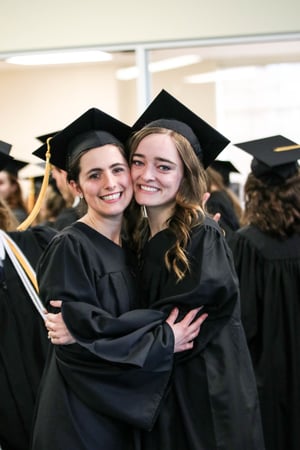
Graduates – Since its founding in 2000, the College has graduated over 1,350 students. Alumni have attended top-tier law schools including Harvard University, Yale University, the College of William & Mary, Duke University, and the University of Virginia, as well as respected graduate programs in other fields at Georgetown University, Johns Hopkins University, and The Catholic University of America (click here for additional graduate and law schools). They hold positions ranging from associate producers at news outlets, editors at publishing companies, and teachers at classical Christian schools to law clerks, legislative assistants, and analysts at intelligence agencies and other federal departments.
The 4-year graduation rate is 59% (2021 cohort); the 6-year graduation rate is 74% (2019 cohort). Data provided by responding alumni one year after Commencement indicates 100% of graduates were employed or in graduate school (source: 2024 Alumni One Year Post BA Survey). In a survey administered 5 years after graduation, 54% of alumni had applied to graduate/law schools, of which 100% were accepted and 100% enrolled in one of their top three choices (2024 Alumni Five-Year Post-BA Survey). The College does not offer and does not calculate placement rates for certificate programs or programs leading to licensure.
Admissions – A rigorous application process emphasizing academic preparation, community outreach and civic involvement, faith and purpose, and analytical/writing skills. ♦ Entrance examination scores for full-time, first-time freshmen in Fall 2024 had a mid-range of 1245-1408 for the SAT (single iteration, Math+Critical Reading) ♦ The middle 50% of students score in Critical Reading were between 670-740 (703 average) and 580-680 in Math (627 average). Students completing the ACT had a mid-range of 26-31 (29 average). Students completing the Classical Learning Test (CLT) had a mid-range of 91-106 (97 average).
Student Learning Outcomes – Commencing seniors in May 2024 received an average score of 465 on the ETS Proficiency Profile (ETS PP)—an average higher than 100% of all participating student scores (n=136,289 with an average 434.9). Average student sub-scores in Critical Thinking, Reading, Writing, Humanities, and Social Sciences were in the 99th percentile (source: comparative reports for seniors, all institution types, over 5 years ending June 30, 2024).
Institutional Outcomes – Additional goals and student achievement outcomes are available here.
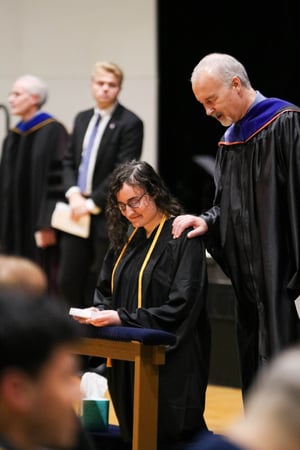
Patrick Henry College has 19 full-time faculty members, 17 of whom possess terminal degrees in their field; PHC's faculty includes prolific scholars and experienced practitioners. A complete list of faculty is available by clicking here.

Patrick Henry College offers academically excellent baccalaureate-level education in ten majors:
Classical Liberal Arts – Students study classics, history, literature, philosophy, and biblical studies; apprenticeships provide contextual learning in the development of practical skills from content area expertise. This is one of two programs at PHC recommended for Pre-Med students.
Economics & Business Analytics – Students study economics, calculus and statistics, ethics, and business-related courses. A substantial co-operative component through an off-campus partner company will provide valuable experience and the application of economics principles and analytics to the study of a particular business, preparing students for the business world, graduate school, or public policy fields.
Environmental Science & Stewardship – Studying biology, chemistry, physics, hydrology, statistics, geology, ecology, calculus, and more, students in the ESS major are equipped to fulfill their divinely appointed role as stewards of the Creation who apply multi-disciplinary solutions to environmental problems. Optional tracks include Law & Policy, Science Pedagogy, and Pre-Med.
Government– Students begin with required introductory courses and numerous specialized courses in four areas of emphasis (American Politics & Policy, International Politics & Policy, Political Philosophy, Political Theory, and Strategic Intelligence) all of which invite students to interact with historic and contemporary political thinkers, discipline classics, and primary sources. Students receive guidance from faculty in conducting research and writing projects and on-the-job, applied training from field specialists.
History– Students take advanced courses in American, European, and World history, as well as historical research and historiography. With an emphasis on graduate school preparation, they engage in specialized research under the guidance of history faculty.
Integrated Math & Natural Sciences- Students are trained in how to think empirically about the world around us and how to apply a biblical worldview to the natural sciences. Expanding on the PHC Core Curriculum’s science classes, students take advanced courses in Biology and Physics while adding Statistics, Calculus, and Chemistry.
Journalism & Digital Media– Students gain extensive writing experience, developing professional competency in a variety of core journalistic tasks and exploring how the historical and Christian foundations of journalism shape contemporary practice. Students also gain experience in creating digital content.
English– Students engage in rigorous discussion and workshop criticism, interacting extensively with critical scholars as they study linguistics, theory, genre, and major historic and contemporary authors; students read and write literary criticism as well as their own creative and scholarly works under the supervision of published authors and critics.
Strategic Intelligence in National Security– Students in this program are provided with a rigorous and systematic study of the intelligence discipline and equipped to influence the intelligence and national security endeavors of the United States. Students in this major may opt for a track in Cyber & Artificial Intelligence.
Theology & the Bible- Students are trained to research and write at a high level and to handle concepts and arguments with precision and detail. Students will be spurred to grow in maturity in Christ and in love for God’s Word. The Theology & the Bible Major is designed to join the highest academic rigor with a deep Protestant commitment, set within the classical liberal arts tradition and made flexible for students pursuing a variety of vocations.
Patrick Henry College also offers a variety of minors that can be integrated into the major course of study:
Classics– Students emerge from the Classics minor thoroughly trained in Greek, Latin, and Greek and Roman history, art, and literature. The Classics Minor prepares students for graduate school in Classics, or simply to possess a traditional classical education that has dominated Western civilization for thousands of years.
Economics & Business Analytics–The Economics & Business Analytics minor exposes students to the basic components of economics and mathematical analysis. The minor will equip students with a biblically-based understanding of economics and business and prepare them to understand and participate in various aspects of business and analysis.
Government– The Government minor equips students with the basic knowledge of the operations, scope, variety, and theoretical underpinnings of government. Required courses in American Political Institutions and International Relations provide students with exposure to both domestic and international politics and policy.
Integrated Math & Natural Sciences– The Integrated Math & Natural Sciences minor provides additional study in mathematics and natural sciences while building on PHC’s liberal arts Core Curriculum. Students study the natural world through advanced classes in Math and Physical Sciences taught in the context of a Biblical worldview. Students choose from electives in Math, Physical Science, and Life Sciences.
History– The History minor offers students the opportunity to enrich their education with the discipline of history. Students emerge from the History minor thoroughly trained in research methods, historiography, and the histories of a variety of eras and locales.
Journalism– The Journalism Minor prepares students of any major to write for news and other non-fiction publications. Students will develop basic writing and reporting skills and be introduced to key concepts that will help them develop a biblically-based understanding of journalism.
Music– The Music Minor offers specialized instruction and experience in music, reinforcing and building on the solid foundation of the liberal arts core. The courses in the Music Minor offer experience in Music Theory, Aural Skills, Conducting, Music Pedagogy, and Art and Worship in the Church.
Philosophy– Students in the Philosophy Minor take four foundational philosophy courses: Metaphysics, Epistemology, Philosophy of Religion, and Ethics. Students emerge with a foundational understanding of both historical and contemporary philosophy. They are prepared for a variety of vocations rooted in the liberal arts such as philosophy, law, writing, and public policy.
Theology & the Bible– The Theology & the Bible minor provides a rigorous and well-rounded training in theology and the study of the Bible in the Protestant tradition. The classes focus on biblical studies, systematic theology, historical theology, and apologetics. Students will build research and writing skills as they learn to handle ideas and arguments with precision while building a love for God's Word.

Patrick Henry College's location, 50 miles northwest of Washington, D.C., presents ample internship and scholarship opportunities for students, who consistently are offered internships in the executive branch of government, U.S. Congress, an array of think tanks and non-profits,Washington Times, National Geographic, USA Today, NBC and Fox affiliates, Defense Intelligence Agency, Federal Bureau of Investigation, National Geo-Spatial Intelligence Agency, National Archives, published authors, private K-12 classical schools, and many others.
Intercollegiate & Intramural Culture – Students participate in an array of intercollegiate scholarship and educational opportunities, including fellowships with the Foundation for Defense of Democracies (FDD) and the Intercollegiate Studies Institute (ISI), and championship forensics with the National Forensics Association (NFA), Collegiate Forensics Association (CFA), National Christian College Forensics Association (NCCFA), National Parliamentary Debate Association (NPDA), and American Collegiate Moot Court Association (ACMA), and American Mock Trial Association (AMTA). Intramural activities include an active Student Government Association, theater club (Eden Troupe), chorale, orchestra, and numerous student-run organizations ranging from filmmaking teams to literary societies. Campus-wide events include daily Chapel and biannual Faith & Reason Lectures.